Free Step 1-style question
Child with extreme photosensitivity, early freckling, and squamous cell carcinoma has xeroderma pigmentosum from defective nucleotide excision repair
A 6-year-old boy is brought to the dermatologist because of a nonhealing, ulcerated nodule on the bridge of his nose that has been enlarging for the past 3 months. His parents report that since early infancy, the boy has had marked sun sensitivity with severe sunburns after minimal sunlight exposure. Physical examination reveals extensive freckling, solar lentigines, and several areas of dry, scaly skin on the face, neck, and dorsal surfaces of the hands. Histopathologic examination of the nasal nodule confirms the diagnosis of squamous cell carcinoma.
The findings in this patient are most likely caused by a defect in which of the following DNA repair processes?
- A. Addition of repetitive hexanucleotide sequences to chromosomal ends
- B. Correction of base-pairing errors during DNA replication
- C. Repair of double-strand DNA breaks by nonhomologous end joining
- D. Removal of a single damaged base by a specific glycosylase
- E. Recognition and excision of damaged oligonucleotide sequences
Correct answer: E. Recognition and excision of damaged oligonucleotide sequences
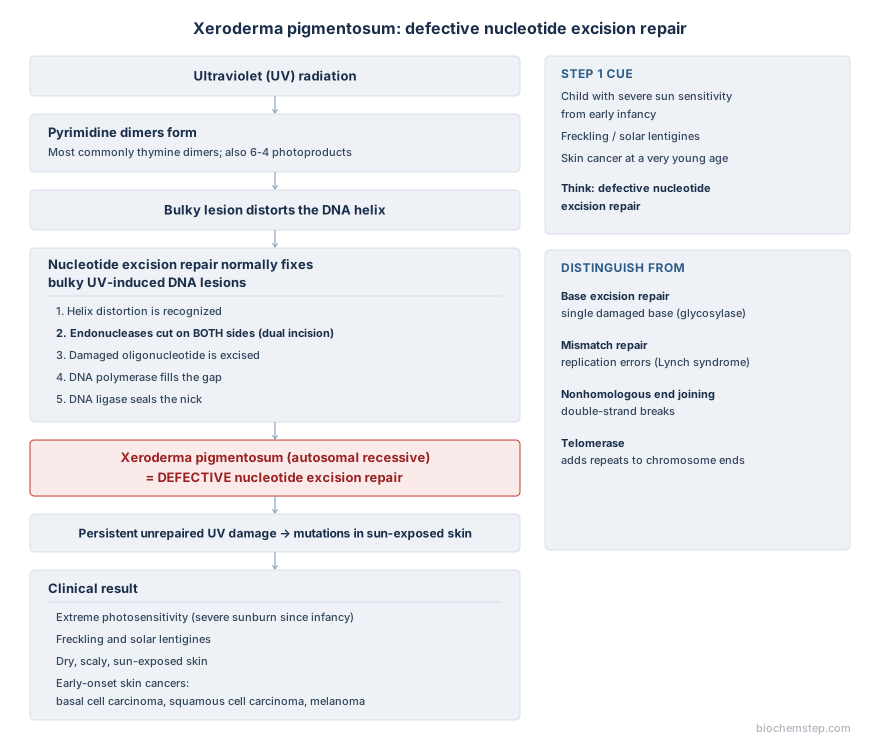
This patient has xeroderma pigmentosum, an autosomal recessive disorder caused by a defect in nucleotide excision repair. Exposure to ultraviolet radiation causes formation of pyrimidine dimers, most commonly thymine-thymine dimers, as well as 6-4 photoproducts, which create bulky lesions that distort the DNA helix. Nucleotide excision repair is the primary mechanism used to repair these lesions. In this pathway, repair proteins recognize the helix distortion, endonucleases cleave the damaged strand on both sides of the lesion, an oligonucleotide containing the damaged bases is excised, DNA polymerase fills the gap using the intact strand as a template, and DNA ligase seals the remaining nick. Patients with xeroderma pigmentosum have extreme photosensitivity and develop skin cancers such as basal cell carcinoma, squamous cell carcinoma, and melanoma at an early age.
Takeaway
Xeroderma pigmentosum is caused by a defect in nucleotide excision repair. This pathway normally recognizes and excises bulky DNA lesions such as ultraviolet-induced pyrimidine dimers. The disorder causes extreme photosensitivity and early-onset skin malignancies.
What this page covers
Practice Step 1-style biochemistry questions on Xeroderma pigmentosum due to defective nucleotide excision repair, including Child with extreme photosensitivity, early freckling, and squamous cell carcinoma has xeroderma pigmentosum from defective nucleotide excision repair, with emphasis on enzyme / mechanism and answer-choice reasoning.
Step 1 practice focus
This preview is organized around Xeroderma pigmentosum due to defective nucleotide excision repair in DNA Repair and Cancer Therapy within Molecular Biology. It is intended for students practicing enzyme / mechanism questions, where the goal is to connect the vignette clue pattern to the underlying biochemical pathway, enzyme defect, metabolite change, regulatory step, or physiologic consequence.
How to use this page
Review the topic and reasoning focus, then practice Step 1-style questions inside BiochemStep. The question set emphasizes mechanism-first answer-choice reasoning rather than passive content review.