Free Step 1-style question
Infant with doll-like facies, massive hepatomegaly, and fasting hypoglycemia with lactic acidosis.
An 8-month-old boy is brought to the pediatrician for evaluation of several episodes of tremors, sweating, and irritability that occur when he goes for more than 4 hours without feeding. Physical examination reveals a protuberant abdomen with a palpable liver edge 5 cm below the costal margin and a doll-like facial appearance with full, rounded cheeks. Laboratory studies are obtained and the results are shown below.
| Test | Value | Reference range |
|---|---|---|
| Serum glucose | 38 mg/dL | 70–110 mg/dL |
| Serum lactate | 6.4 mmol/L | 0.5–2.2 mmol/L |
| Serum uric acid | 12.1 mg/dL | 2.0–7.0 mg/dL |
| Serum triglycerides | 510 mg/dL | 35–135 mg/dL |
Which of the following is the most likely diagnosis?
- A. Andersen disease
- B. Cori disease
- C. McArdle disease
- D. Pompe disease
- E. Von Gierke disease
Correct answer: E. Von Gierke disease
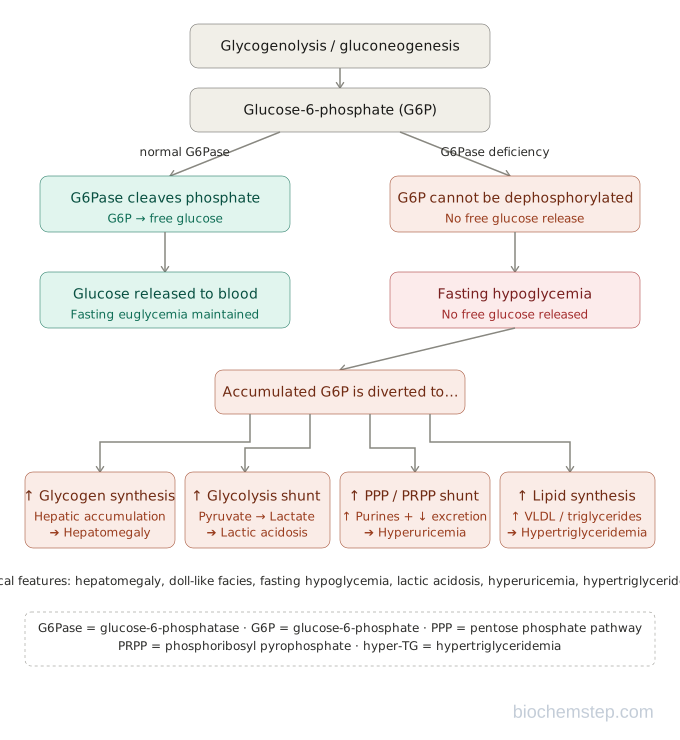
This infant's fasting-triggered tremors and sweating, hepatomegaly with doll-like facies, hypoglycemia, lactic acidosis, hyperuricemia, and hypertriglyceridemia are characteristic of von Gierke disease (glycogen storage disease type I), caused by deficiency of glucose-6-phosphatase. This enzyme catalyzes the final step of both glycogenolysis and gluconeogenesis, converting glucose-6-phosphate to free glucose, so its deficiency causes severe fasting hypoglycemia with little or no increase in blood glucose after glucagon administration. Accumulated glucose-6-phosphate is diverted into alternative pathways: increased glycolytic flux contributes to lactic acidosis, and increased lipid synthesis contributes to hypertriglyceridemia and hepatic steatosis. Hyperuricemia reflects both increased urate production and reduced renal urate excretion. Excess glucose-6-phosphate entering the pentose phosphate pathway increases ribose-5-phosphate and PRPP availability for purine synthesis, while fasting hypoglycemia and glucagon-driven ATP degradation also increase urate production; elevated lactate further reduces urate excretion by competing with urate for proximal tubular organic acid transport.
Takeaway
Von Gierke disease (Type I GSD) is caused by glucose-6-phosphatase deficiency, resulting in severe fasting hypoglycemia, hepatomegaly, lactic acidosis, hyperuricemia, and hypertriglyceridemia.
What this page covers
Practice Step 1-style biochemistry questions on Von Gierke disease, with emphasis on clinical diagnosis vignette and answer-choice reasoning.
Step 1 practice focus
This preview is organized around Von Gierke disease in Glycogen Storage Diseases within Carbohydrate Metabolism. It is intended for students practicing clinical diagnosis vignette questions, where the goal is to connect the vignette clue pattern to the underlying biochemical pathway, enzyme defect, metabolite change, regulatory step, or physiologic consequence.
How to use this page
Review the topic and reasoning focus, then practice Step 1-style questions inside BiochemStep. The question set emphasizes mechanism-first answer-choice reasoning rather than passive content review.