Free Step 1-style question
Infant with developmental regression, cherry-red macular spot, and no hepatosplenomegaly.
A 7-month-old boy is brought to the pediatrician because of loss of previously achieved motor milestones. His parents report that he is no longer able to sit unsupported. Physical examination reveals generalized hypotonia and poor head control. Fundoscopic examination is notable for a bright red spot at the macula surrounded by a pale, opaque retina. Abdominal examination reveals no palpable liver or spleen.
Which of the following is the most likely diagnosis?
- A. Fabry disease
- B. Gaucher disease
- C. Krabbe disease
- D. Niemann-Pick disease
- E. Tay-Sachs disease
Correct answer: E. Tay-Sachs disease
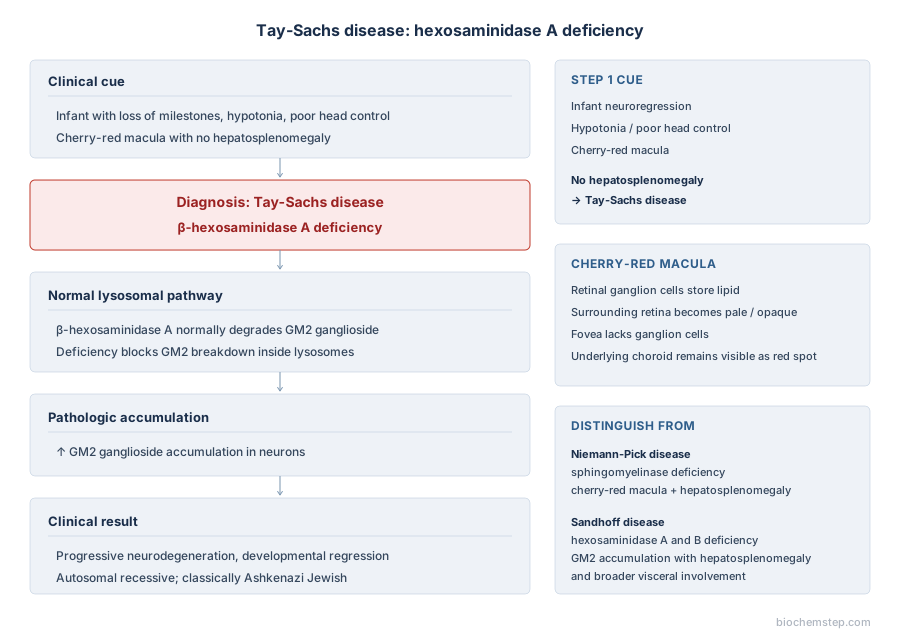
Developmental regression, hypotonia, a cherry-red macular spot, and absence of hepatosplenomegaly in this infant are consistent with Tay-Sachs disease. This autosomal recessive lysosomal storage disease is caused by deficiency of hexosaminidase A, which results in accumulation of GM2 ganglioside within neuronal lysosomes. The accumulation causes progressive neurodegeneration, typically beginning between 3 and 6 months of age. The cherry-red spot occurs because lipid-laden retinal ganglion cells make the surrounding macula appear pale, while the central fovea remains red. Histology classically reveals membranous cytoplasmic bodies with onion skin-like concentric lamellar inclusions.
Takeaway
Tay-Sachs disease is caused by hexosaminidase A deficiency, leading to GM2 ganglioside accumulation in neuronal lysosomes. It is distinguished from Niemann-Pick disease by the absence of hepatosplenomegaly, although both can present with developmental regression and a cherry-red macular spot.
What this page covers
Practice Step 1-style biochemistry questions on Tay-Sachs disease (hexosaminidase A), with emphasis on clinical diagnosis vignette and answer-choice reasoning.
Step 1 practice focus
This preview is organized around Tay-Sachs disease (hexosaminidase A) in Sphingolipidoses within Genetics & Cell Biology. It is intended for students practicing clinical diagnosis vignette questions, where the goal is to connect the vignette clue pattern to the underlying biochemical pathway, enzyme defect, metabolite change, regulatory step, or physiologic consequence.
How to use this page
Review the topic and reasoning focus, then practice Step 1-style questions inside BiochemStep. The question set emphasizes mechanism-first answer-choice reasoning rather than passive content review.