Free Step 1-style question
Infant with developmental regression, hyperacusis, hypotonia, cherry-red macula, and no hepatosplenomegaly has Tay-Sachs disease
A 7-month-old boy is brought to the pediatrician by his parents because he is no longer as active as he used to be. The parents report that at 5 months of age, the infant was able to roll from his stomach to his back, but he can no longer perform this movement. They also note that he becomes markedly startled by loud noises. Physical examination reveals an infant with generalized hypotonia and decreased spontaneous movement. Funduscopic examination reveals bilateral cherry-red spots on the macula. The liver and spleen edges are not palpable.
Deficiency of which of the following enzymes is the most likely cause of this patient's condition?
- A. Alpha-galactosidase A
- B. Beta-glucocerebrosidase
- C. Beta-hexosaminidase A
- D. Galactocerebrosidase
- E. Sphingomyelinase
Correct answer: C. Beta-hexosaminidase A
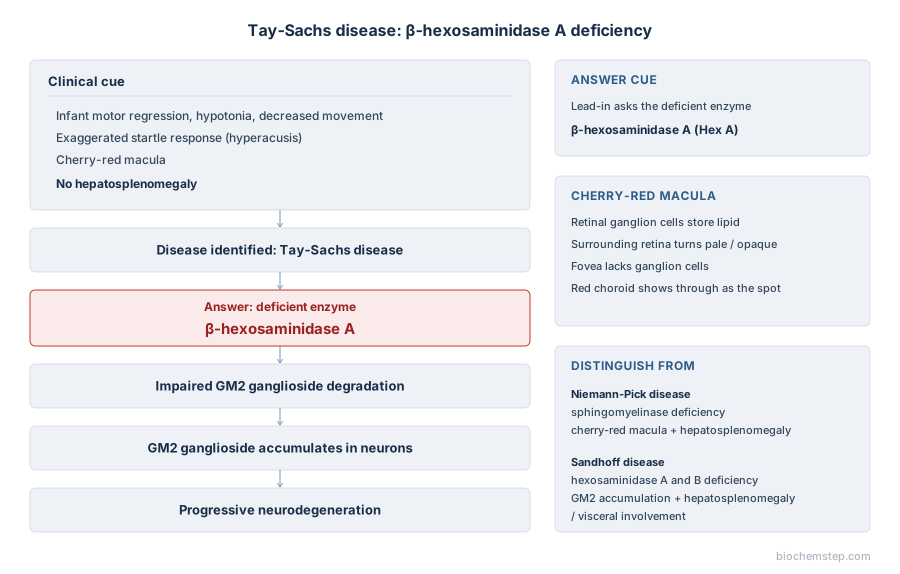
This patient has Tay-Sachs disease, suggested by developmental regression, hyperacusis, hypotonia, and a cherry-red macula. Tay-Sachs is an autosomal recessive lysosomal storage disorder caused by deficiency of beta-hexosaminidase A. This leads to accumulation of GM2 ganglioside within neuronal lysosomes, causing progressive neurodegeneration. Neurons are selectively vulnerable because they are rich in gangliosides and lack an alternative pathway for GM2 degradation.
Takeaway
Tay-Sachs disease is caused by deficiency of beta-hexosaminidase A, leading to accumulation of GM2 ganglioside. It classically presents with developmental regression, hyperacusis, and a cherry-red macula, without hepatosplenomegaly.
What this page covers
Practice Step 1-style biochemistry questions on Tay-Sachs disease due to beta-hexosaminidase A deficiency, including Infant with developmental regression, hyperacusis, hypotonia, cherry-red macula, and no hepatosplenomegaly has Tay-Sachs disease, with emphasis on enzyme / mechanism and answer-choice reasoning.
Step 1 practice focus
This preview is organized around Tay-Sachs disease (hexosaminidase A) in Sphingolipidoses within Genetics & Cell Biology. It is intended for students practicing enzyme / mechanism questions, where the goal is to connect the vignette clue pattern to the underlying biochemical pathway, enzyme defect, metabolite change, regulatory step, or physiologic consequence.
How to use this page
Review the topic and reasoning focus, then practice Step 1-style questions inside BiochemStep. The question set emphasizes mechanism-first answer-choice reasoning rather than passive content review.