Free Step 1-style question
Pediatric patient with developmental delay, dystonic movements, hyperuricemia, and self-injurious behavior.
A 14-month-old boy is brought to the clinic for evaluation of developmental delay and intermittent abnormal movements. His mother reports that he has become increasingly irritable and that she has noticed faint orange staining in several diapers. His mother also notes that he has recently begun biting his lower lip, occasionally causing bleeding. Physical examination shows generalized hypotonia with intermittent dystonic posturing. Laboratory studies are obtained.
| Test | Value | Reference range |
|---|---|---|
| Serum uric acid | 9.8 mg/dL | 2.0–5.5 mg/dL |
Which of the following is the most likely diagnosis?
- A. Adenosine deaminase deficiency
- B. Glucose-6-phosphatase deficiency
- C. Lesch-Nyhan syndrome
- D. Ornithine transcarbamylase deficiency
- E. Orotic aciduria
Correct answer: C. Lesch-Nyhan syndrome
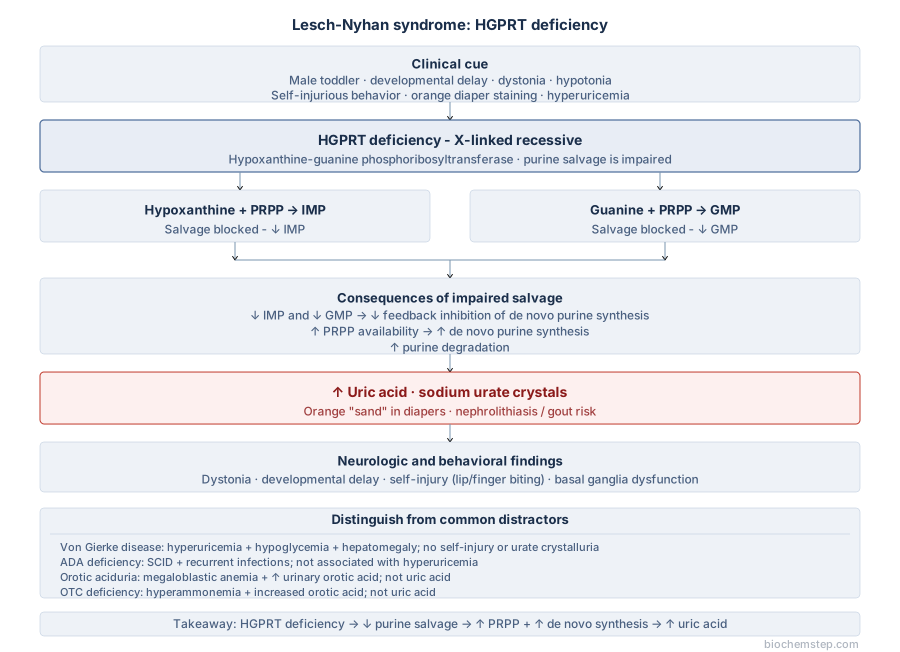
Lesch-Nyhan syndrome is the most likely diagnosis in this patient with early childhood neurologic dysfunction, hyperuricemia, orange diaper staining from urate crystals, and self-injurious behavior. This X-linked recessive disorder results from deficiency of hypoxanthine-guanine phosphoribosyltransferase (HGPRT), an enzyme in the purine salvage pathway. HGPRT normally salvages hypoxanthine to inosine monophosphate (IMP) and guanine to guanosine monophosphate (GMP). Loss of HGPRT decreases salvage of hypoxanthine and guanine, increasing their degradation to uric acid. It also reduces IMP and GMP feedback inhibition and increases PRPP availability, which stimulates de novo purine synthesis. The net effect is excess purine production and catabolism, causing hyperuricemia and sodium urate crystal formation. The neurologic and behavioral manifestations are incompletely understood but are associated with basal ganglia dysfunction, including abnormalities in dopaminergic signaling.
Takeaway
Lesch-Nyhan syndrome results from HGPRT deficiency, which impairs purine salvage and drives excess uric acid production through both increased purine degradation and compensatory de novo synthesis; neurologic dysfunction and self-injurious behavior distinguish it from other causes of pediatric hyperuricemia.
What this page covers
Practice Step 1-style biochemistry questions on Lesch-Nyhan syndrome (HGPRT deficiency), with emphasis on clinical diagnosis vignette and answer-choice reasoning.
Step 1 practice focus
This preview is organized around Lesch-Nyhan syndrome (HGPRT deficiency) in Purine Metabolism within Nucleotide Metabolism. It is intended for students practicing clinical diagnosis vignette questions, where the goal is to connect the vignette clue pattern to the underlying biochemical pathway, enzyme defect, metabolite change, regulatory step, or physiologic consequence.
How to use this page
Review the topic and reasoning focus, then practice Step 1-style questions inside BiochemStep. The question set emphasizes mechanism-first answer-choice reasoning rather than passive content review.