Free Step 1-style question
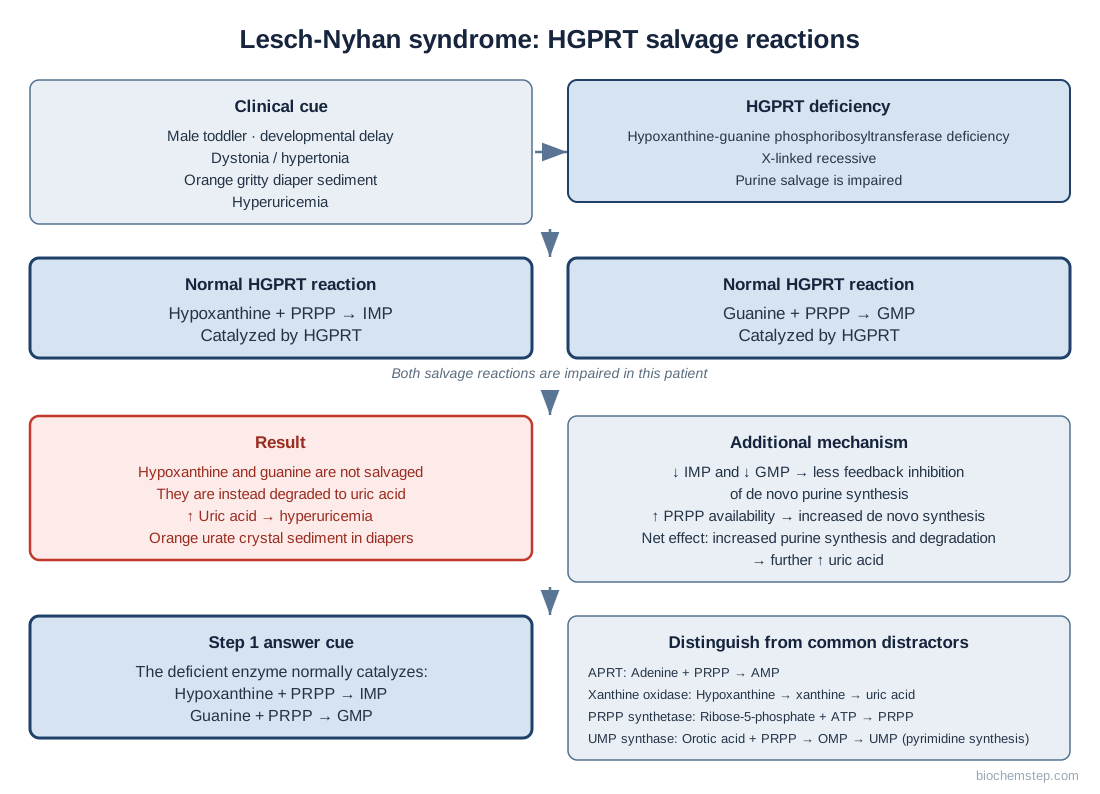
Toddler with developmental delay + dystonia + orange urate sediment in diapers + hyperuricemia = Lesch-Nyhan syndrome; deficient reaction = guanine + PRPP to GMP
A 22-month-old boy is brought for evaluation of delayed motor development and abnormal movements. He has never sat independently or crawled and does not speak any words. Since early infancy, his parents have intermittently noticed orange, gritty material in his diapers. Over the past several months, he has developed recurrent involuntary twisting movements of the arms and trunk. Physical examination shows generalized hypertonia and intermittent dystonic posturing. Laboratory studies are shown below.
| Test | Value | Reference range |
|---|---|---|
| Serum uric acid | 12.4 mg/dL | 2.0-5.5 mg/dL |
The findings in this patient are most likely caused by deficiency of an enzyme that normally catalyzes which of the following reactions?
- A. Conversion of adenine and phosphoribosyl pyrophosphate to adenosine monophosphate
- B. Conversion of guanine and phosphoribosyl pyrophosphate to guanosine monophosphate
- C. Conversion of hypoxanthine to xanthine
- D. Formation of phosphoribosyl pyrophosphate from ribose 5-phosphate
- E. Conversion of orotic acid to orotidine 5'-monophosphate
Correct answer: B. Conversion of guanine and phosphoribosyl pyrophosphate to guanosine monophosphate
This child has Lesch-Nyhan syndrome, an X-linked recessive disorder caused by deficiency of hypoxanthine-guanine phosphoribosyltransferase (HGPRT). HGPRT is a purine salvage enzyme that catalyzes two reactions: hypoxanthine + phosphoribosyl pyrophosphate → inosine monophosphate guanine + phosphoribosyl pyrophosphate → guanosine monophosphate Deficiency of HGPRT impairs purine salvage, so hypoxanthine and guanine are instead degraded to uric acid. This leads to hyperuricemia and can produce orange urate sediment in diapers during infancy. HGPRT deficiency also causes accumulation of phosphoribosyl pyrophosphate and reduced feedback inhibition by inosine monophosphate and guanosine monophosphate, which increases de novo purine synthesis and further increases uric acid production. Neurologic findings commonly include developmental delay, dystonia, choreoathetosis, and hypertonia. The classic self-injurious behavior of Lesch-Nyhan syndrome may develop later in early childhood, but it is not required to recognize the disorder.
Takeaway
Lesch-Nyhan syndrome is caused by HGPRT deficiency, which impairs purine salvage. The resulting hyperuricemia, developmental delay, and dystonia reflect failure to salvage hypoxanthine and guanine, with secondary overproduction of uric acid due to increased de novo purine synthesis.
What this page covers
Practice Step 1-style biochemistry questions on Lesch-Nyhan syndrome and HGPRT deficiency, including Toddler with developmental delay, dystonia, orange urate sediment in diapers, hyperuricemia, with emphasis on enzyme / mechanism and answer-choice reasoning.
Step 1 practice focus
This preview is organized around Lesch-Nyhan syndrome (HGPRT deficiency) in Purine Metabolism within Nucleotide Metabolism. It is intended for students practicing enzyme / mechanism questions, where the goal is to connect the vignette clue pattern to the underlying biochemical pathway, enzyme defect, metabolite change, regulatory step, or physiologic consequence.
How to use this page
Review the topic and reasoning focus, then practice Step 1-style questions inside BiochemStep. The question set emphasizes mechanism-first answer-choice reasoning rather than passive content review.