Free Step 1-style question
Smoke inhalation patient with severe lactic acidosis and neurologic deterioration; tests impaired tissue oxygen extraction in mitochondrial poisoning.
A 34-year-old warehouse worker is brought to the emergency department after being rescued from an enclosed storage area where burning plastics and synthetic materials produced heavy smoke. He was not wearing respiratory protection. He is unconscious and has rapid, deep respirations. Physical examination shows hypotension followed by a generalized tonic-clonic seizure. Laboratory studies are obtained.
| Test | Value | Reference range |
|---|---|---|
| Arterial pH | 7.12 | 7.35–7.45 |
| Bicarbonate | 8 mEq/L | 22–28 mEq/L |
| Lactate | 14 mmol/L | 0.5–2.2 mmol/L |
Which of the following biochemical consequences is most likely present in this patient?
- A. Accumulation of oxidized cytochrome c
- B. Decreased mitochondrial NADH/NAD⁺ ratio
- C. Decreased venous oxygen content
- D. Increased mitochondrial oxygen consumption
- E. Increased mixed venous oxygen saturation
Correct answer: E. Increased mixed venous oxygen saturation
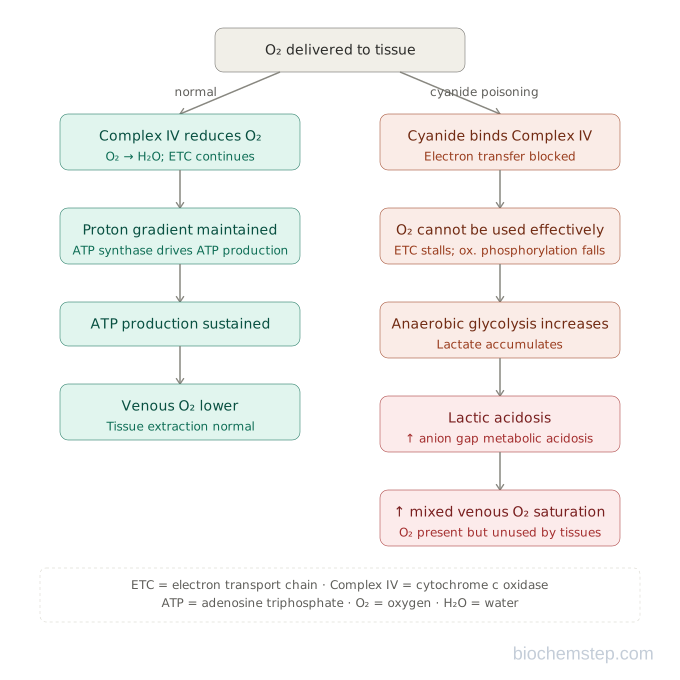
Unconsciousness, seizures, hypotension, and profoundly elevated lactate with severe metabolic acidosis in a patient rescued from an enclosed fire involving burning plastics and synthetic materials point to cyanide toxicity from smoke inhalation. Cyanide binds the ferric iron in the heme a3 component of cytochrome c oxidase, also called Complex IV, preventing electron transfer to oxygen in the mitochondrial electron transport chain. Because oxidative phosphorylation is blocked, cells cannot effectively use delivered oxygen for aerobic ATP production and must rely on anaerobic glycolysis, producing marked lactate accumulation. Impaired tissue oxygen extraction leaves more oxygen in venous blood, causing increased mixed venous oxygen saturation and a narrowed arterial-to-venous oxygen difference despite cellular hypoxia.
Takeaway
Cyanide poisoning inhibits cytochrome c oxidase by binding ferric iron in Complex IV. This blocks mitochondrial oxygen utilization, causing severe lactic acidosis with impaired tissue oxygen extraction and increased mixed venous oxygen saturation.
What this page covers
Practice Step 1-style biochemistry questions on Cyanide poisoning, with emphasis on metabolic consequence / accumulation / deficiency and answer-choice reasoning.
Step 1 practice focus
This preview is organized around Cyanide poisoning in Oxidative Phosphorylation within Integrated Metabolism & Physiology. It is intended for students practicing metabolic consequence / accumulation / deficiency questions, where the goal is to connect the vignette clue pattern to the underlying biochemical pathway, enzyme defect, metabolite change, regulatory step, or physiologic consequence.
How to use this page
Review the topic and reasoning focus, then practice Step 1-style questions inside BiochemStep. The question set emphasizes mechanism-first answer-choice reasoning rather than passive content review.