Free Step 1-style question
Post-myocardial infarction patient taking daily low-dose antiplatelet therapy that also has analgesic properties at higher doses.
A 65-year-old man is seen for a 6-month follow-up after a myocardial infarction. As part of his long-term secondary prevention regimen, he takes a daily low-dose medication that reduces platelet aggregation. At higher doses, the same medication is also used for its analgesic and antipyretic properties. Laboratory studies demonstrate reduced platelet thromboxane A2 production.
Which of the following most accurately describes the molecular mechanism by which this medication achieves its antiplatelet effect?
- A. Blockade of the glycoprotein IIb/IIIa receptor on the platelet surface
- B. Covalent acetylation of a serine residue in the cyclooxygenase active site
- C. Inhibition of phosphodiesterase III to increase platelet cAMP levels
- D. Irreversible binding to the P2Y12 adenosine diphosphate receptor
- E. Reversible competition with arachidonic acid at the cyclooxygenase active site
Correct answer: B. Covalent acetylation of a serine residue in the cyclooxygenase active site
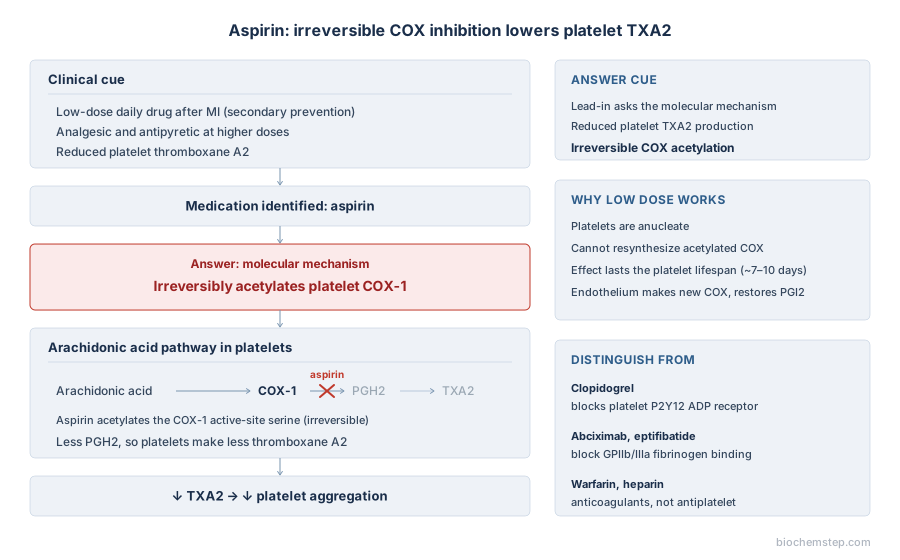
This patient is taking low-dose aspirin for secondary prevention after myocardial infarction. This patient's use of a low-dose antiplatelet agent with analgesic and antipyretic properties at higher doses, combined with reduced platelet thromboxane A2 production, is consistent with aspirin. Aspirin irreversibly inhibits cyclooxygenase by covalently acetylating a serine residue in the enzyme's active site. The antiplatelet effect is mediated primarily by inhibition of platelet cyclooxygenase-1, which decreases synthesis of thromboxane A2, a mediator that promotes platelet aggregation and vasoconstriction. Because platelets are anuclear and cannot synthesize new cyclooxygenase, aspirin's effect on platelet thromboxane production persists for the lifespan of the platelet, approximately 7 to 10 days. Endothelial cells can synthesize new cyclooxygenase enzymes, which helps preserve prostacyclin production relative to platelet thromboxane production after low-dose aspirin exposure.
Takeaway
Aspirin irreversibly inhibits platelet cyclooxygenase-1 by covalent acetylation of an active-site serine residue. This decreases thromboxane A2 synthesis and reduces platelet aggregation. The combination of low-dose antiplatelet use with analgesic and antipyretic properties at higher doses distinguishes aspirin from other antiplatelet agents.
What this page covers
Practice Step 1-style biochemistry questions on Aspirin and irreversible cyclooxygenase inhibition, with emphasis on enzyme / mechanism and answer-choice reasoning.
Step 1 practice focus
This preview is organized around Aspirin and irreversible cyclooxygenase inhibition in Suicide inhibitors / irreversible inhibition within Enzyme Kinetics. It is intended for students practicing enzyme / mechanism questions, where the goal is to connect the vignette clue pattern to the underlying biochemical pathway, enzyme defect, metabolite change, regulatory step, or physiologic consequence.
How to use this page
Review the topic and reasoning focus, then practice Step 1-style questions inside BiochemStep. The question set emphasizes mechanism-first answer-choice reasoning rather than passive content review.